

Overweight babies are often seen as cute and cuddly, but where do we draw the line with childhood obesity? What is socially acceptable, and what is not?
Childhood obesity is one of the conditions that is increasing in my practice, and it is quite worrisome. According to the State of the World’s Children, 2019: Children, food and nutrition (2019), South Africa has the highest percentage (13%) of overweight children under the age of five years in Eastern and Southern Africa, 27.4% of South African children under the age of five years are stunted (too short for their height), and 61% children under five years suffer from anaemia (iron deficiency).
Childhood obesity may lead to a series of health problems such as impaired glucose tolerance, diabetes, breathing problems (asthma and sleep apnoea), joint and muscle-skeletal ache, high blood pressure, high cholesterol, fatty liver disease and heartburn, psychological and social problems which includes discrimination and poor self-esteem.
So why, after looking at all the health problems, would you say is childhood obesity on the rise? Is one of the latest health trends in South Africa not focused on healthy eating and exercise? According to De Ridder and Coetzee (2015), one of the causes is due to lack of physical education in schools offered by well-trained teachers and Klingberg et al. (2019) states that other causes include barriers to healthy behaviours (sub-optimal equipment in schools and unhealthy food items available in cafeterias), high cost of healthy foods, gendered notions of acceptable behaviour, body image and beauty ideals. Other possible causes include the westernisation of our diets and the urbanisation of our country.
How do we stop this deadly cycle? We lead by example. Your child looks up to you as a parent – monkey see, monkey do. If you focus on being healthy by exercising and being active, the chances are high that your child will also want to do the same. Try some fun and adventurous activities over a weekend – go for a bike ride as a family, go for a hike, go to your local swimming pool and spend the day there.
You are the single biggest influence on your child, especially when it comes to eating. You need to make healthy food choices as often as possible. Teach your child that healthy food is still enjoyable and tastes good, even if you do not like that specific food.
Some practical tips you can include in your daily routine to help your child combat obesity:
- Get some paper (green, yellow and red), glue, scissors, and magazines. Ask your child to go through the magazines and collect different pictures of different food items. Help your child create a traffic light with all the food pictures. At the green light, you put pictures of food they are allowed to eat daily, at the yellow light you put pictures of food which they are allowed to eat once a week and at the red light you put pictures of food they are allowed to eat once a month. Put the traffic light up on the fridge and use that to teach your child about healthy eating.
- Make sure your child starts their day with a healthy breakfast such as a high fibre cereal (oats, All-Bran flakes, or Oat-Bix).
- Packing a healthy lunch box for school is incredibly important. Make sure you pack a fresh fruit instead of a fruit juice or cold drink, pack some vegetables your child enjoys eating such as tomatoes, carrots, and cucumber. Their lunch box should also contain a whole grain product (low GI bread, Provitas, Ryvitas, or whole wheat wraps) and a protein (egg, shredded chicken breast, lean mince, lean biltong, or low-fat cheese). Make sure to pack a water bottle as well.
- Encourage your child to be active and restrict time playing on the play station or watching TV.
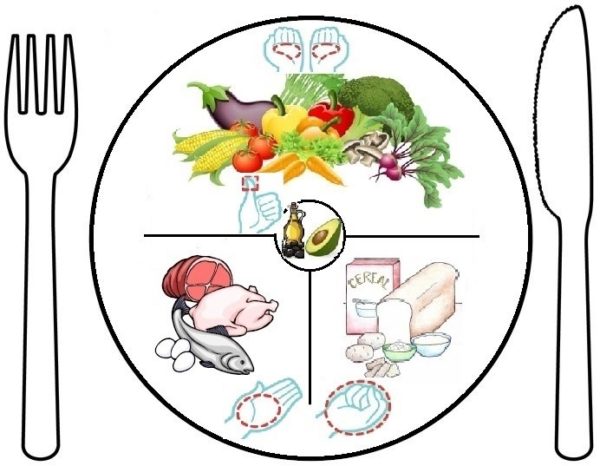
- Teach your child how to prepare a healthy meal and what their plate should look like. Get them involved in food preparation. See a plate model below.
- Eat together as a family at a set table and talk to each other about the day.
Remember, it is important to seek professional advice from your paediatrician or dietitian regarding your child’s health and weight. We are here to help you get the monkeys healthy!
For the joy of food,
Until next time
Lezane
References:
- UNICEF. State of the World’s Children: 2019. Available at https://www.unicef.org/reports/state-of-worlds-children-2019
- De Ridder, J.H; Coetzee, D. Childhood obesity in South Africa: Are we sitting on a time bomb? ResearchGate, 2015:1-14.
- Klingberg, S; Draper, C.E; Micklesfield, L.K; Benjamin-Neelon, S.E; van Sluijs, E.M.F. Childhood obesity prevention in Africa: A Systematic Review of Intervention Effectiveness and Implementation. International Journal of Environmental Research and Public Health, 2019.